Medicaid and CHIP enrollment fell about 1% in July 2026 to 72.9 million. Here's what the numbers show and why the two CMS reports don't match.

The July drop, and why the number will likely move
Medicaid and CHIP enrollment fell about 1.0% in July 2026, a decline of roughly 708,000 people. The Centers for Medicare & Medicaid Services released the monthly figures, and they put total enrollment at 72.9 million. Of those, 65.7 million were in Medicaid and 7.2 million were in CHIP. Adults accounted for 38.1 million Medicaid enrollees, and children plus CHIP enrollees totaled 34.9 million.

Treat that July number as a first look. The monthly reports are preliminary, and they're often revised upward or downward about a month later. If you're comparing one month's report with the one before it, a gap between the two can come from revisions rather than from people actually leaving coverage.
Still, the direction is clear. The all-time high for Medicaid and CHIP came in April 2023, at 94.1 million people, or 95.7 million once U.S. territories are included. Current enrollment sits well below that peak.
Two CMS reports, two different pictures
This is the part most people miss. CMS publishes two separate enrollment reports, and they don't measure the same thing.
The first is the monthly Medicaid & CHIP Enrollment Trend Snapshot, which is the source of the July figures. It runs about four months behind, with data through March 2026. The second is the Medicaid Budget & Expenditure System (MBES) report, which is about a year behind, with data through June 2025. Because of that lag, any MBES figure you see will describe a period well before the Trend Snapshot's latest month.
The methods differ too. MBES counts unduplicated individuals who were enrolled at any time during each month. The Trend Snapshot's performance indicator data counts people enrolled on the last day of the month. MBES covers only people whose coverage is funded through Medicaid, while the published performance indicator also includes CHIP. MBES also includes people in limited benefit plans and covers American Samoa, Guam, the Northern Mariana Islands, Puerto Rico and the U.S. Virgin Islands.
Data for the two reports can come from different state systems, and states may generate them on different dates. Retroactive adjustments can also be in progress. Put all of that together and you get a useful rule of thumb: compare like with like, and check the report name and date range before drawing conclusions.
Territory figures illustrate the point. MBES showed about 1.44 million Medicaid enrollees in U.S. territories as of June 2025. Add that to the Trend Snapshot total for the 50 states and DC and you reach roughly 74.4 million. That number blends a 2025 territory count with a 2026 state count, so treat it as a rough combined figure rather than a single-date total.
Expansion enrollment and the longer trend
ACA Medicaid expansion enrollment was 20.4 million as of June 2025, according to MBES. That's about 3.6 million below its May 2023 high. Expansion adults make up a large share of the overall decline, so readers following coverage for low-income adults in expansion states should watch that series closely.
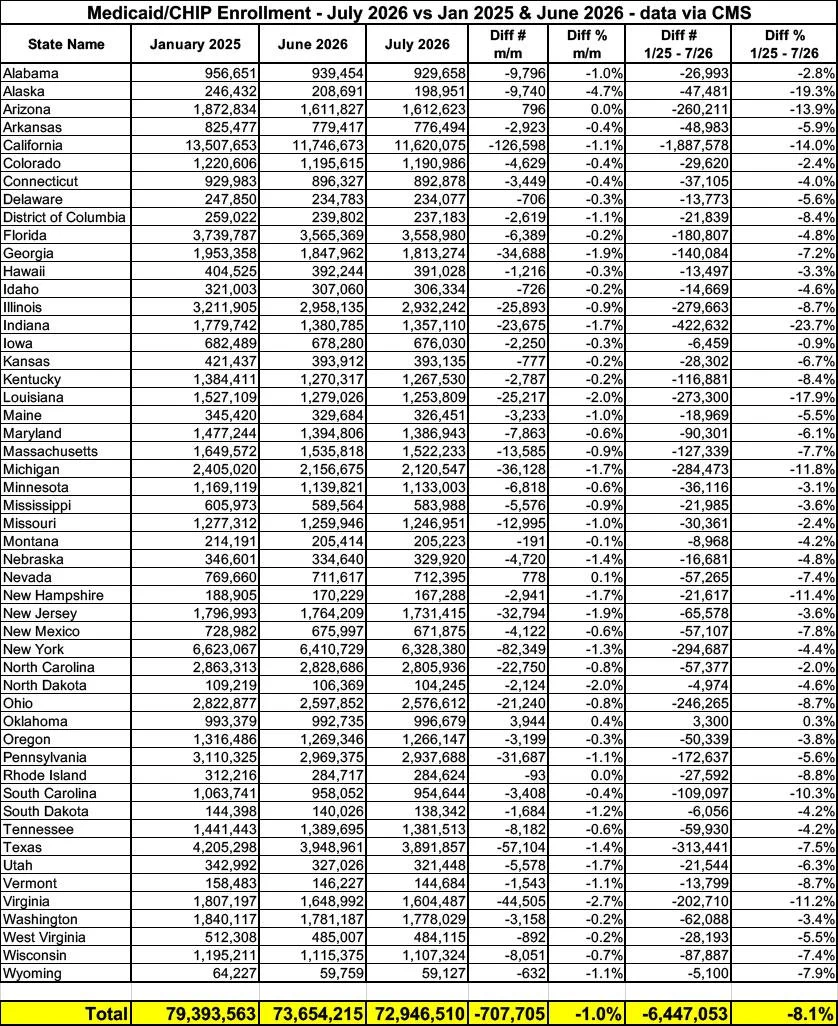
Zoom out to the period since January 2025, when the current administration took office. Net Medicaid and CHIP enrollment has dropped by more than 6.4 million people, or 8.1%. The decline isn't spread evenly, though.
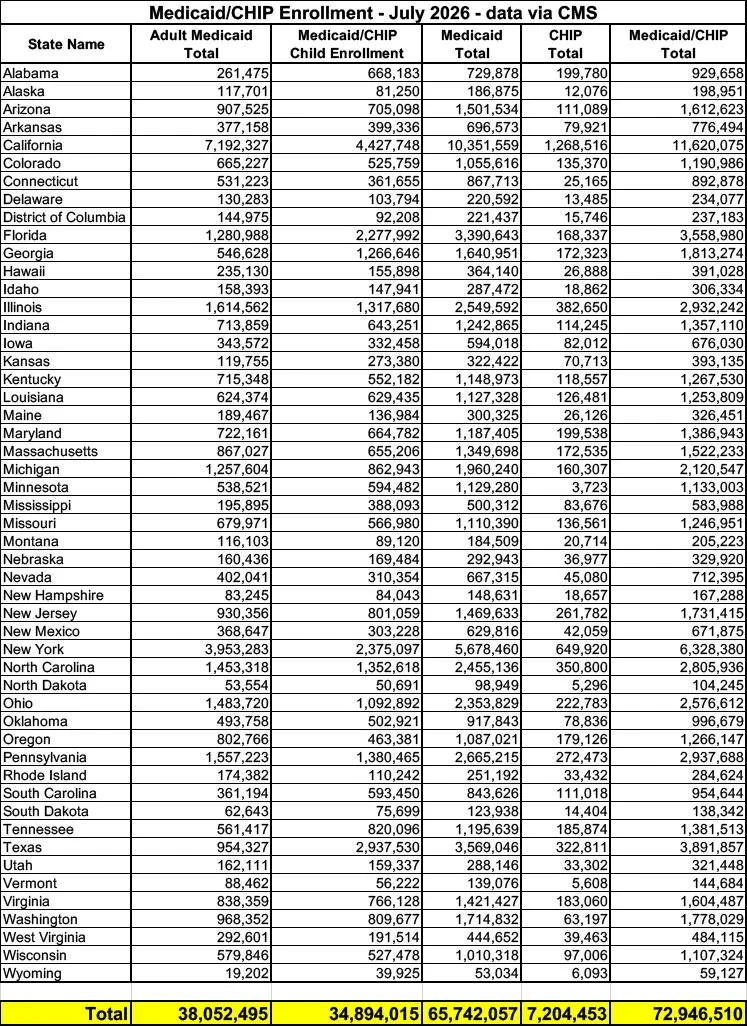
Oklahoma shows virtually no net change over that stretch. Indiana sits at the other end, with a 23.7% drop, which works out to 422,000 fewer enrollees than at the start of the period. In raw numbers, California leads by a wide margin, with nearly 1.9 million people removed from its Medicaid and CHIP rolls, a 14% decline.
Is falling enrollment a good sign?
Here's the thing: fewer people on Medicaid isn't automatically bad news. If someone moved to individual marketplace coverage, Medicare or employer-sponsored insurance, they may simply have changed plans. That's the scenario everyone hopes for.
The data doesn't give us a clean answer. Two factors make the optimistic reading harder to sustain. First, the ACA marketplace has faced enrollment pressure this year, which limits where people can land. Second, unemployment rose, with about 200,000 more Americans out of work in June 2026 than in December 2024, according to the Bureau of Labor Statistics. Job losses often bring coverage losses, and the two trends are worth reading together.
Medicare enrollment, by contrast, has grown by more than 1.74 million since January 2025. That growth partly offsets the Medicaid and CHIP decline on paper. But most of the new Medicare enrollees didn't switch over from Medicaid or CHIP. Many aged out of employer coverage, and others turned 65 and moved in from ACA plans or other types of coverage. A Medicare increase, in other words, doesn't tell you where the Medicaid people went.
What to do if your coverage changed
If you or someone in your household has lost Medicaid or CHIP coverage, a few steps can help you avoid a gap. Check the notice you received and note the effective date. Ask whether anyone in the household qualifies for another type of coverage, and gather income and employment records, since those usually drive eligibility decisions. If you're a small-business owner whose employees are affected, it's worth reviewing how your group health plan and any coverage-related communications are set up. Keep copies of everything, because documentation makes it easier to resolve questions later.
Watch the next Trend Snapshot release. Because July's numbers are preliminary, the revised figures will show whether the drop holds. And if you want to check the underlying data yourself, the Medicaid & CHIP Enrollment Trend Snapshot and the MBES reports are the places to start.