Private motorcycle sales in Ontario hinge on a UVIP, a signed bill of sale and a six-day registration window. Here's what each side needs to do.
Private motorcycle sales in Ontario run on a short paper trail: a Used Vehicle Information Package, a signed bill of sale, a split ownership permit and a six-day registration window. Get the order right and the transfer takes an afternoon. Get it wrong and the bike sits in a driveway for a month.
Buyers are the ones who usually get caught out, mostly because proof of insurance has to exist before they walk into ServiceOntario. That's the detail I'd sort out first, even before the price is settled.
Why the sequence matters
Ontario treats the transfer as a paper handoff with a fixed order. Skip a step or do them out of sequence and you get familiar problems: a buyer who can't register because the seller kept the wrong half of the permit, a seller still on the hook for a bike that left weeks earlier, or a motorcycle that can't be plated until someone finds a licensed mechanic.
The steps below draw on the province's used vehicle page. Where that page doesn't answer a question, the answer here points you to ServiceOntario instead of guessing.
The seller's side
If you're selling, the paperwork falls to you first, so start before the listing goes up.
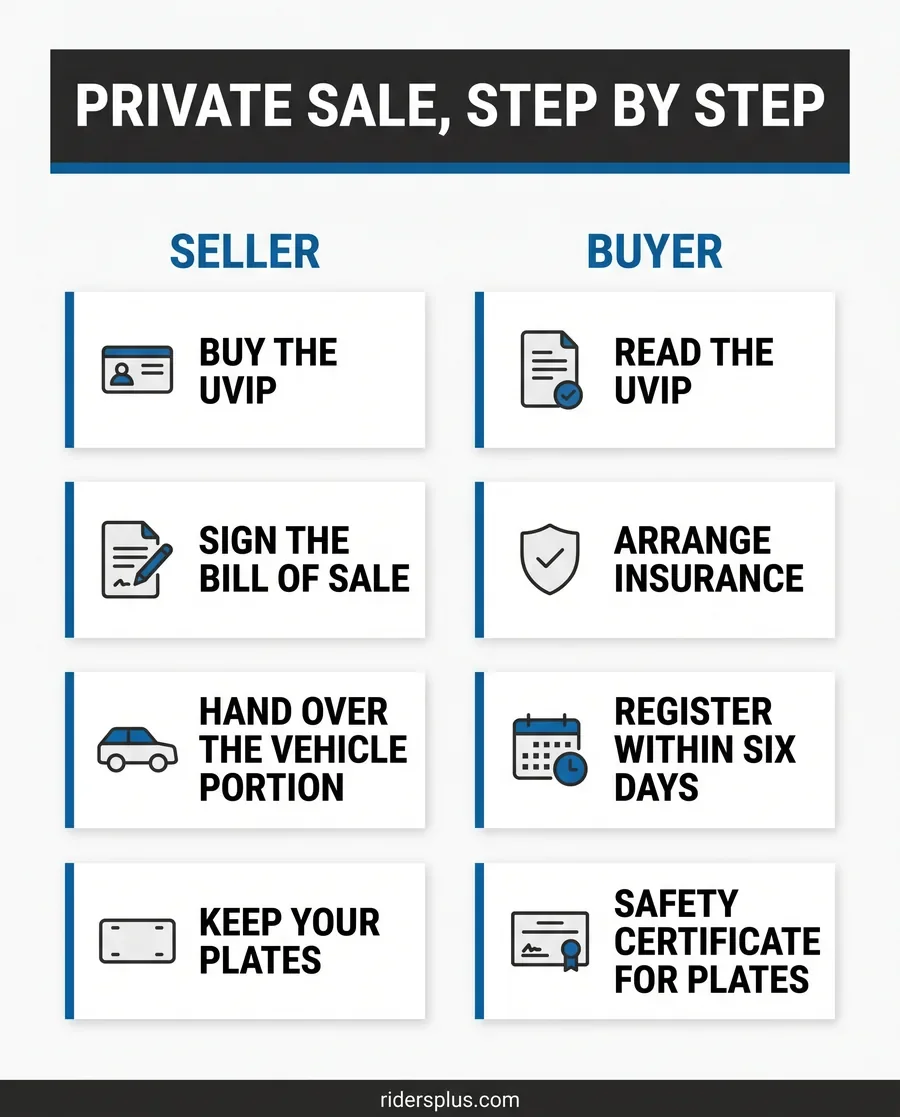
- Buy the Used Vehicle Information Package (UVIP). Under the Highway Traffic Act, the seller has to give the buyer a UVIP. It lists the bike's registration history, lien information and retail sales tax details, and it includes a bill of sale section at the bottom. You can order it online or at a ServiceOntario centre.
- Match the VIN to your permit. The number on the frame has to line up with your green ownership document. If it doesn't, sort that out before anything else.
- Confirm nothing is owed on the bike. A lien attaches to the motorcycle rather than to you, and a buyer will look for it on the UVIP.
- Complete the bill of sale. It needs your name and address, the buyer's name and address, your signature, and the sale date. It has to be an original document, and handwriting is fine. The bottom of the UVIP works.
- Sign the transfer portion of the permit. The permit has two halves. The vehicle portion goes to the buyer. The plate portion stays with you.
- Keep the plates. In Ontario, plates travel with the driver, not the vehicle. Remove them before the buyer rides off. You can put them on another bike, or ask ServiceOntario about a refund on any unused validation.
- Hand over the right paperwork. That means the UVIP, the signed bill of sale, the vehicle portion of the permit, and a Safety Standards Certificate if you've decided to provide one.
One habit isn't on any government page but saves hassle: call your insurance broker once the bike is gone, so it comes off your policy and nothing lingers on your account.
Pro tip
Photograph every page you hand over, including the signed bill of sale and the buyer's licence beside it. If someone asks months later who owned the bike on a given date, the photos will answer that faster than memory will.
The buyer's side
For buyers, the clock starts the moment money changes hands.
- Read the UVIP before you pay. Check the registration history, look for liens, and confirm the VIN matches the bike in front of you. If the seller can't produce a UVIP, treat that as your first warning sign.
- Get the signed bill of sale and the vehicle portion of the permit. Both documents should be signed and dated by both parties.
- Arrange insurance before the ServiceOntario visit. You can't register the bike without proof of insurance. A broker can set up coverage on a bike you're about to buy, using the VIN from the UVIP, so the paperwork is ready when you need it. Getting a motorcycle insurance quote for that specific bike also tells you what you're committing to before you agree on a price.
- Register within six days. The new owner has to register the vehicle in their name within six days of purchase. Bring proof of insurance, your Ontario driver's licence, the UVIP, the bill of sale, and a Safety Standards Certificate if you want plates issued the same day.
- Pay the tax and collect the permit and plates. Retail sales tax is worked out at ServiceOntario at the time of transfer. The figure depends on the sale and the bike's wholesale value, so get the exact amount at the counter rather than estimating it yourself.
- Mount the plate and check the sticker rules. Validation requirements can change, so confirm what applies to motorcycles when you're there.
The Safety Standards Certificate, explained
A Safety Standards Certificate (SSC) comes from a licensed Ontario mechanic at a DriveON inspection station. It confirms the bike met the province's safety standards on the day it was inspected. In a transfer, the certificate is what lets the buyer get plates issued.
Without one, a bike can usually still be registered in the new owner's name. It just can't be plated and ridden until a certificate is provided. That distinction matters if you're planning a same-day ride home.
Who pays for the certificate is a matter for buyer and seller to settle. Sellers sometimes include one to make the bike easier to move. Buyers sometimes prefer to book their own inspection with a shop they trust. Either way, think of the SSC as a snapshot of roadworthiness on one day, not a guarantee the bike will stay sound. Ask ServiceOntario or the inspection station how long a certificate stays valid for registration, because timing a sale around an expired one is a common way to lose a week.
Mistakes that cost a week
- Buying without a UVIP. The seller is required to provide one. If they won't, that's your cue to walk away.
- Leaving plates on the bike. The plates belong to the seller. Riding on someone else's plates means riding on someone else's registration.
- Missing the six-day window. Deadlines don't move for busy schedules.
- Arriving at ServiceOntario without insurance. No proof of insurance means no registration. Sort it the week before.
- Incomplete bill of sale. A missing date, a missing address or a single signature will send you back to the seller.
- Treating the SSC as a full inspection. A passed certificate means the bike cleared a safety check on one day. Have a mechanic you trust look it over too, especially if the bike has been modified in ways that can affect insurance.
Red flag
A seller who wants to meet somewhere other than the address on the permit, can't produce a UVIP, or has a name that doesn't match the ownership document is describing a bike you should think twice about. Pause the deal until the paperwork lines up.
Three situations worth a call first
Some transfers need answers before anyone signs. Check with ServiceOntario first if the UVIP shows a lien, if the bike is moving between family members (separate rules apply to gifts between family, including tax treatment), or if the motorcycle has been rebuilt or has a replaced frame.
The insurance side works the same way: make the call before the sale, not after. A broker can tell you what coverage looks like on the specific bike, which is far easier to plan around than a rushed decision at the counter.
Your questions, answered
Can I ride the bike home on the seller's plates? No. Plates stay with the seller because they travel with the driver, not the vehicle. Plan on a trailer or truck for the trip home, or check ServiceOntario for a temporary option. Buyers who expect to ride away the same day often learn this at the worst moment, so build the pickup around it.
What if the seller doesn't have the ownership permit? Hold off on completing the sale. You need the vehicle portion to register the bike, and a seller without it may not be the registered owner. A replacement permit can be obtained through ServiceOntario by the registered owner, so a legitimate seller can close that gap. A seller who can't or won't is telling you something.
Do I need insurance before I own the motorcycle? In practice, yes. You need proof of insurance to register the bike, and registration has to happen within six days of purchase. Arranging coverage ahead of the sale date, using the VIN from the UVIP, means the documents are ready the day you need them.
Is a Safety Standards Certificate always required? It's required to have plates issued to the new owner, not to transfer the registration itself. A bike can generally be registered without one and stay unplated until a certificate is obtained. Confirm current rules and certificate validity with ServiceOntario or the inspection station, since both can change.
Here's the short version. Sellers: order the UVIP, pull the plates before the bike leaves, and call your broker once it's gone. Buyers: read the UVIP, line up insurance, and book the ServiceOntario visit inside the six-day window. Both sides should photograph every signed page. That single habit has settled more disputes than any other step in this process.