Missouri’s final 2027 average increases are 12.3% for individual plans and 16.5% for small group coverage, with changes varying by carrier and plan.
Missouri’s final average premium increases for 2027 are 12.3% in the individual market and 16.5% in the small group market. Those figures give buyers a clearer statewide picture than the preliminary filings, but they don’t predict what any one person or employer will pay: plan, location, age and other rating factors can affect the price.
The final figures were posted on November 2, 2026, as the 2027 Open Enrollment Period began. Individual carrier rates changed only slightly from their preliminary filings, while small group rates were approved at the amounts initially filed. The source doesn’t give revised carrier-by-carrier averages, so the preliminary figures below provide context rather than a complete final rate card.
Coverage losses add pressure to the individual market
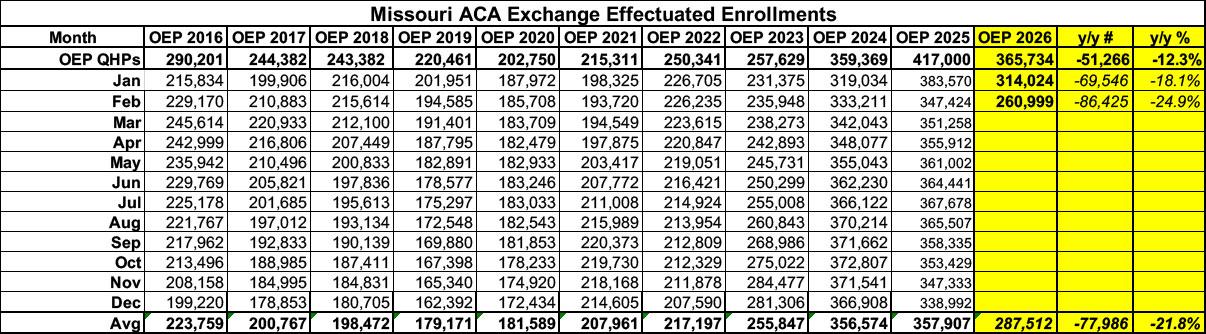
The final rate picture follows a sharp decline in Missouri individual market enrollment. The source reports that enrollment fell 25% after enhanced subsidies expired at the end of the previous year. Initial Open Enrollment signups were already more than 12% below the prior enrollment period. Coverage that took effect was down 18% year over year in January and 25% in February.
That decline amounted to more than 86,000 Missourians losing individual market health coverage, according to the article. These enrollment figures offer important context for the rate filings: insurers set prices using assumptions about who will enroll and the medical costs of the people who remain covered. A change in the mix of enrollees can affect those estimates, alongside the cost and use of health services.
The source compares monthly enrollment with 2025 and 2019, the last full year before the COVID period and before the enhanced subsidies were in place. Its linked chart and table show those comparisons.

Preliminary carrier filings show a wide spread
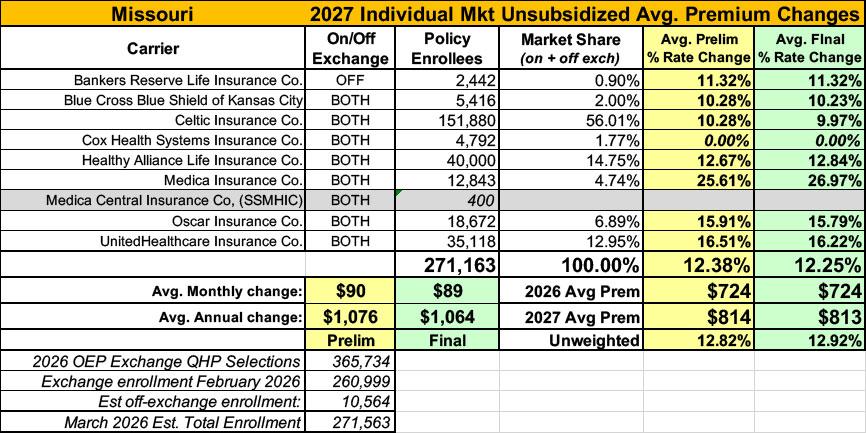
Before the final rates were posted, Missouri carriers in the individual market sought a preliminary average increase of 12.4%. The filings showed substantial variation: several proposed increases were around 10% to 16%, while Medica Insurance Company requested a 25.6% average increase. Carrier averages don’t translate directly into a given enrollee’s price, and the final statewide 12.3% figure should not be read as a guaranteed change for each plan.
Medica Central Insurance Company did not appear in the preliminary summary or have a filing listed. The source suggests it may be leaving Missouri, and says the company had only a few hundred enrollees who might have moved into the main Medica Insurance Company. That possibility is not confirmed in the material provided.

What individual carriers included in their filings
Bankers Reserve Life Insurance Company proposed an 11.3% increase affecting 2,442 members. Its filing identified worsening statewide health risk as the leading driver. The company said its filing did not have enough experience of its own to produce a reliable estimate, and used 2025 claims and other information from Celtic Insurance Company through March 31, 2026.
Bankers Reserve reported 2025 claims of $529.03 per member per month. It estimated a medical loss ratio of 74.1% for 2025 and projected 86.5% for 2027. A medical loss ratio, or MLR, measures the share of premium used for member claims and activities that improve care quality. The filing also cited increased use of medical services, risk adjustment and statewide average premium calculations. Benefits were unchanged from 2026. Projected administrative costs were $95.67 per member per month in 2027, compared with a reported 2026 figure of $75.27.
Blue Cross and Blue Shield of Kansas City listed a 10.6% overall average increase for its individual plans, with plan changes ranging from 5.5% to 16.2%. Its filing said 5,416 members were enrolled in affected plans as of April 30, 2026. The filing describes the average increase in one section as 10.4%, as well as reporting 10.6% overall; the source does not explain the difference. Neither average includes the additional annual price change that can come as a member gets older.
The company reported a 2025 MLR of 103.5%, meaning medical and drug claims exceeded premium and risk transfer received. Its projected 2027 MLR was 84.0%. It expected medical costs to rise 9.3% from 2026 to 2027 because of greater service use and higher service prices, while expecting improvements in the covered group’s average health to reduce medical and drug costs by 4.6%. Administrative expenses were projected at 11.9% of premium, down from an assumed 13.8% for 2026. The filing also said plan benefit and enrollment changes contributed to a 3.2% reduction in 2026 rates.
Celtic Insurance Company, which offers Ambetter Health plans, proposed a 10.3% increase affecting 151,880 members. It identified increases in the price of services as its main driver. Ambetter began operating in Missouri in 2018, initially offering plans in 40 counties; it said it planned to offer plans in 109 counties for 2027.
Celtic used 2025 claims and other information through March 31, 2026, and reported a 2025 claim cost of $464.71 per member per month. The company projected an MLR increase from 76.9% in 2025 to 83.5% in 2027, citing rising claims and premium changes. Its filing said benefits would not change from 2026. It also listed cost sharing reductions for qualifying members with Silver plans, risk adjustment, rising use of care and administrative expenses as elements in its pricing process. Projected 2027 administrative expenses were $92.06 per member per month, compared with a historical 2026 figure of $80.67.
Cox Health Systems Insurance Company said it planned individual plans in Barry, Christian, Greene, Lawrence, Stone, Taney and Webster counties. It stated that all current 2026 plans would end and that only new plans would be offered in 2027. The filing described rising medical and pharmacy claim costs, estimating annual health care cost growth of 9.9%. It also cited higher hospital costs at Cox Medical Centers and an expected risk adjustment payment.
For the company’s Missouri individual market, the filing described premium and cost experience for 2023, 2024 and 2025, saying its MLR exceeded 80% in each year and no refund was due. Its projected 2027 premium allocation was 91.0% for medical and pharmacy claims, 7.0% for expenses apart from claims, including taxes and fees, and 2.0% for profit.
Healthy Alliance Life Insurance Company filed an average increase of 12.67%, with plan changes ranging from 10.21% to 15.66%. The changes were expected to affect about 40,000 people who had its plans and planned to keep them for 2027. A person’s actual rate could vary with benefits, location, age, number of children and tobacco use.
The company based its filing on 2025 plan data and assumptions about health risk, the mix of people and plans in 2027, medical and pharmacy cost trends, and operating expenses. It projected claims rising from $496.22 in 2025 to $671.62 in 2027. Administrative expenses were projected at 6.6% of premium, taxes and fees at 5.2%, and a profit and risk margin at 5.1%. The filing projected an 86.1% MLR and said the company would refund the difference if its MLR fell below the required 80% minimum. It reported little change in administrative costs from 2026 to 2027 and said its profit and risk margin matched the prior year’s filing.
Medica Insurance Company requested a 25.6% average increase effective January 1, 2027, affecting an estimated 12,843 members. The filing said changes would differ by plan. It projected claim costs rising from $507.55 per member per month in 2025 to $633.84 in 2027, based on estimates of the covered population, medical and pharmacy costs, taxes and fees.
Medica reported that medical services accounted for 111.0% of premium after taxes and fees were removed in 2025. For 2027, it projected 88.7%. The filing identified changes in both the number and price of services as the largest contributors to its requested increase. It also cited provider pricing and recent claims experience as factors in its estimates. Annual plan design updates can change deductibles, copayments and other cost sharing, so the rate effect can vary by plan. Medica projected 2027 administrative costs of $84.80 per member per month, up from $77.74 in 2025, and identified salaries and benefits, agent commissions, claims processing, information technology, clinical services and network services among the expense drivers.
Oscar Insurance Company sought a 15.9% average increase for renewing individual plans, affecting an estimated 18,672 members. The requested rates were to take effect January 1, 2027, and excluded price changes caused by a member aging. Oscar said increases varied by plan due to benefit design and geographic rating factors.
Its filing cited medical and prescription drug cost trends, administrative costs, taxes and fees, expected profit, anticipated changes in the health of the covered population and revised benefits. Oscar said benefit updates reflected changes to the actuarial value calculator and state requirements, along with new or revised plan offerings. For 2027, it projected 83.8% of premium for claims and risk adjustment transfers, 9.1% for administrative expenses, 5.0% for taxes and fees, and 3.9% for profit. Its projected MLR under the applicable calculation was 86.5%.
UnitedHealthcare Insurance Company filed an overall average increase of 16.5%, with plan changes from 13.4% to 21.1%. The filing said a member’s actual change would depend on plan, location, age, family size and tobacco use. It identified higher medical and pharmacy costs, changes in the average health of the covered group as some healthier members left after subsidy availability changed, and non-claim expenses as pricing factors. Premiums were based on projected claims, plan benefits such as deductibles and copayments, and expenses including overhead, taxes and fees.
Small group coverage
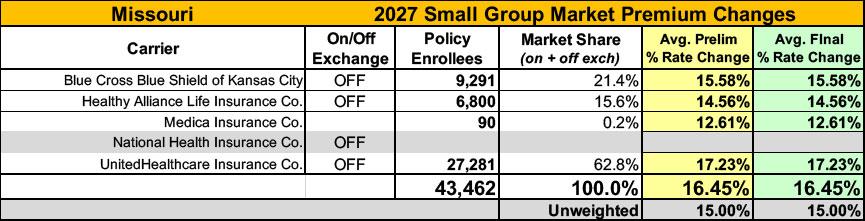
In the preliminary filings, Missouri small group carriers sought a weighted average increase of 16.5% for 2027. National Health Insurance Company did not appear in the summary, and the source said it appeared to be dropping out of the market. The final update reported that small group rates were approved as filed. The material does not provide carrier-level final figures or details about which employers may need to select replacement coverage.

What buyers can take from the final figures
The statewide averages summarize changes across a market; they don’t tell an individual or employer what a particular renewal will cost. In the individual market, filed explanations repeatedly point to medical and prescription drug costs, enrollment mix, plan design, operating expenses and risk adjustment. The filings also show why plan-level results can differ even within one carrier.
For people with individual coverage and small employers reviewing 2027 options, the practical next step is to compare the renewal price and benefits with the alternatives available in their area. Pay attention to the plan’s deductible, copayments, network and other cost sharing alongside its premium. The final statewide increases set the context for those choices, while the member’s own renewal documents will show the price that applies to their coverage.
Missouri’s proposed 2027 rate filings were initially available through the state’s insurance site. The final update linked the Rate Review database, which it said had been updated with final 2027 filings for every state.